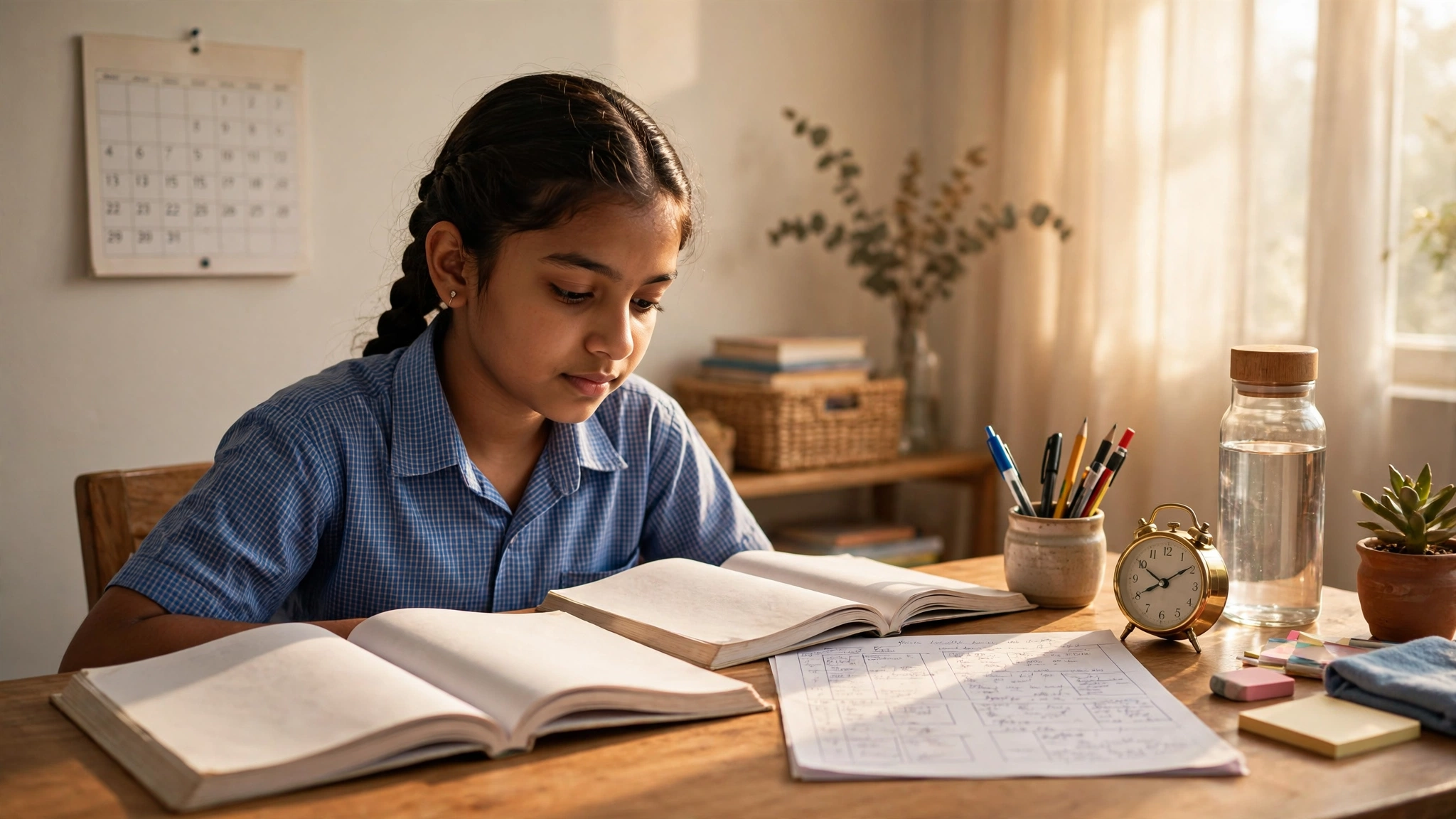
Yes — three months is enough to prepare well for the CBSE Board Exam 2027, if you use the time in the right order: finish the syllabus first, then practise with official sample papers, then revise only from your own notes. The board exams are expected in February–March 2027, based on recent years. The official date sheet for 2027 has not been released yet — check cbse.gov.in for it, and do not trust dates shared on social media.
CBSE Board Exam 2027 — Key Facts
- Exams expected: February–March 2027 (date sheet not yet released)
- Sample papers: Official SQPs and marking schemes for Class 10 and 12 released on 21 September 2026 on cbseacademic.nic.in — no change in question paper design from last year
- Practical exams: Winter-bound schools 9 November–19 December 2026; regular schools from 1 January 2027
- Main theory papers: Most subjects carry 80 theory marks, 3 hours
- First step today: Download your syllabus and sample papers from the official CBSE Academic website only
Your 3-Month Study Plan at a Glance
| Month | Main job | Done when… |
|---|---|---|
| November | Finish the syllabus honestly; find your weak chapters | Every chapter has a one-page summary sheet |
| December | Fix weak chapters; first full revision; start sample papers | No chapter is still “not learned” |
| January | Timed sample papers and previous-year papers; finish practicals | At least 4 full papers per subject, marked with the official marking scheme |
| February | Light revision only — nothing new | Formulas, diagrams, definitions and your error log are revised |
November: Finish the Syllabus, Honestly
Most school syllabi finish by November or early December. Your job this month is not to re-read everything — it is to find out what you actually know. For each subject, make a simple three-column list: chapters you are confident in, chapters you are shaky on, and chapters you have effectively not learned.
Study NCERT first. Complete the prescribed textbooks and all exercises before touching any extra book. For every finished chapter, write a one-page summary in your own words. That sheet becomes your revision material in February.
December: Turn Shaky Chapters into Strong Ones
December is where marks are actually made. Take the shaky column from November and attack it chapter by chapter. After each chapter, solve its questions from previous-year papers. Keep a single error log — one page per subject — noting the chapter and the type of mistake: concept, calculation, presentation, or time management.
January: Sample Papers Under Exam Conditions
January is for converting knowledge into marks. Follow these steps:
- Download the official sample papers for your class from cbseacademic.nic.in — Class 10: SQP_CLASSX_2026-27 page; Class 12: SQP_CLASSXII_2026-27 page. Download the marking scheme (MS) for each paper too.
- Write one full paper per subject per week, in 3 hours, with a pen, no phone, no pausing.
- Mark it yourself using CBSE’s official marking scheme, not a guess.
- Add every mistake to your error log the same day.
- Repeat the weakest paper type the next week — do not just move on.
Sample papers are a preview of the pattern and question types, not a prediction of the exact questions. The 2026-27 papers follow the same question paper design as 2025-26, so last year’s papers are also useful practice.
A Simple Daily Routine That Works
- 2 hours of self-study on school days, split between one strong subject and one weak subject.
- Study in 45–60 minute blocks, with a 5–10 minute break between blocks. Stretch, drink water, walk — do not pick up the phone.
- One hour of revision every day, recalling what you read earlier — active recall beats re-reading.
- 7–8 hours of sleep. A tired brain cannot retain what you studied.
- One day a week, review the plan itself — tick off finished chapters and move the date sheet check to cbse.gov.in.
Class 10 and Class 12: What Is Different
Class 10: This is your first externally-marked exam, and its marks guide your stream choice in Class 11. Give Mathematics and Science daily time, revise formulas and theorems often, and solve sample papers from late December.
Class 12: Your board syllabus overlaps with entrance exams like JEE, NEET and CUET, but it is not identical. Keep the board side separate in your plan — board answers need steps, diagrams and presentation, not just the final answer. English and your optional subjects also carry full weight, so do not ignore them for entrance preparation.
FAQs
Is 3 months enough to prepare for the CBSE board exam 2027?
Yes, if the syllabus finishes by December. Use November for an honest audit, December for weak chapters, January for timed sample papers, and February for light revision only.
When will the CBSE date sheet 2027 be released?
CBSE has not released the 2027 date sheet yet, as of 6 November 2026. It will appear on cbse.gov.in. The exams are expected in February–March 2027, based on recent years.
Where can I download CBSE sample papers 2026-27?
Only from the official CBSE Academic website, cbseacademic.nic.in — Class 10 at https://cbseacademic.nic.in/SQP_CLASSX_2026-27.html and Class 12 at https://cbseacademic.nic.in/SQP_CLASSXII_2026-27.html. Each subject has an SQP link and a marking scheme link.
How many sample papers should I solve?
Aim for at least 4 full papers per subject under timed conditions, starting in January, each marked against the official marking scheme. Quality matters more than count — analyse every mistake the same day.
Source: CBSE Academic website (cbseacademic.nic.in), CBSE notification dated 21 September 2026 on sample question papers; CBSE practical exam circulars for 2026-27.